The Royal Astronomer of Gyeongbokgung
Episode 13: The Edict of Emancipation and the Two Scholars Appointed to Lead the Royal Observatory
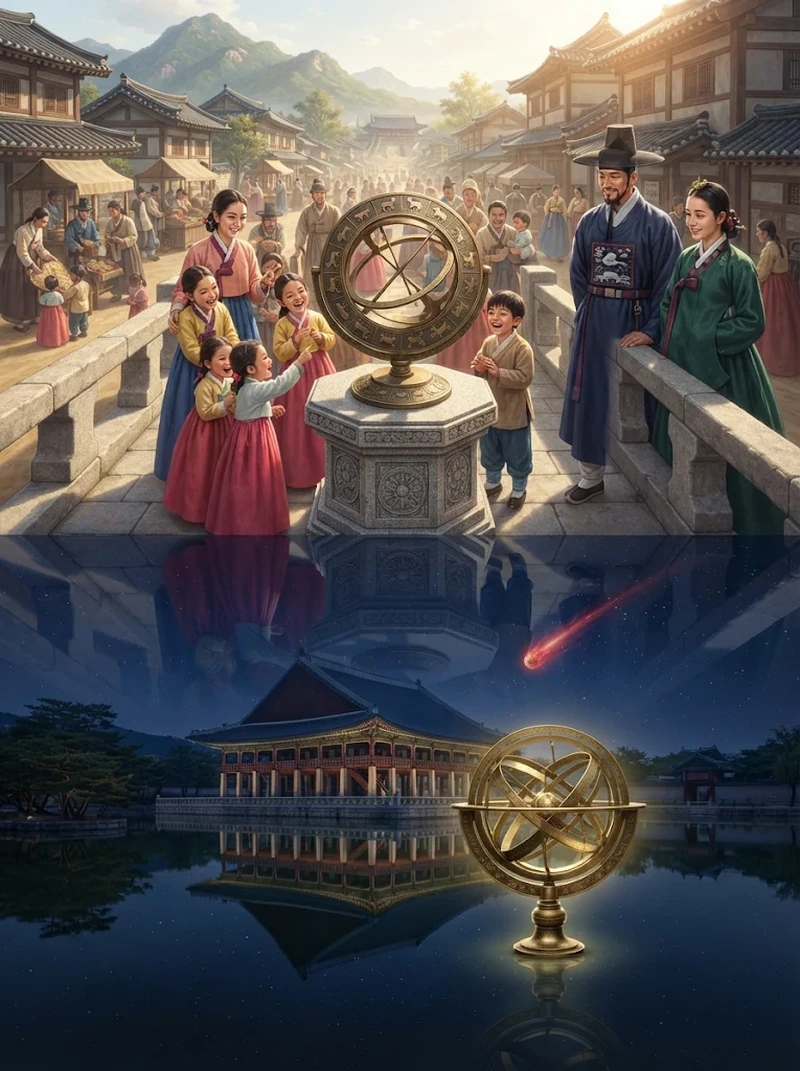
Three days after the 'Chiljeongsan Inner and Outer Volumes' were promulgated across all eight provinces, a special royal investiture ceremony presided over personally by King Sejong was convened inside Sajeongjeon Hall at Gyeongbokgung Palace. Gathered within the royal council chamber were Chief State Councillor Hwang Hui, the ministers of the State Council and the Six Ministries, and all the scholars of the Hall of Worthies and the Royal Observatory, gazing warmly upon Jang Yeong and So-hye as the two bowed side by side before the dragon throne.
Taking two golden-silk royal edicts directly from the Royal Secretary's tray, King Sejong stepped down one pace from the dais and spoke in a voice both benevolent and majestic.
"Let Jang Yeong of the Royal Observatory raise his head. Though you were born into the humble status of a government slave, through your heaven-bestowed eye for observation, your geometric wisdom, and your unshakeable loyalty before every threat, you have completed the Grand Simplified Armillary, the armillary sphere, and the self-striking water clock, and brought forth our Joseon's independent calendar canon, the Chiljeongsan. There is no noble or baseborn among the stars in the heavens—how then could We keep a great scholar who has read the principles of the heavens bound within the outdated status chains of the earth?"
As the King unfurled the first golden-silk edict, every minister in the hall held his breath.
"From this hour forth, We order that the slave registry documents of Jang Yeong and his family be permanently burned, granting him full emancipation forever! Furthermore, We appoint Jang Yeong to the Senior Fifth Rank office of Chief Director of the Royal Observatory—Gwansanggam Jeong—to oversee all celestial observations and astronomical instrument construction at the Gyeongbokgung Observatory and Seoungwan!"
For a former government slave to cross the threshold of status and rise to the Senior Fifth Rank head of the nation's astronomical institution was an unprecedented appointment in Joseon history; yet among the court ministers who had witnessed Jang Yeong's miraculous skill with their own eyes in the courtyard of Gyeonghoeru Pavilion, not a single person raised an objection. When Chief State Councillor Hwang Hui stroked his beard and nodded first in approval, the entire assembly of officials bowed in unison, crying out, "Your Majesty's grace is boundless!"
"Your servant Jang Yeong shall engrave Your Majesty's ocean-deep grace into my very bones! Until the day these eyes and hands fail me, I shall dedicate my entire life solely to the skies of Joseon and the time of our people!"
As Jang Yeong bowed his forehead to the floor in overwhelming gratitude, the King lifted the second golden-silk edict and turned his gaze toward So-hye.
"Let Mathematical Scholar So-hye of the Hall of Worthies also raise her head. Though precedent is rare for a woman to hold formal court office, without the four-variable spherical equations you solved with three thousand bamboo counting rods, our Chiljeongsan would never have seen the light of day. Therefore, We specially bestow upon So-hye the substantive Senior Fifth Rank post of Co-Director of the Royal Observatory and Doctor of Mathematics along with official court robes—so that together with Jang Yeong, the two of you may serve as the twin wings of the Royal Observatory to nurture future scholars and refine our astronomical science!"
Amidst the applause and congratulations filling Sajeongjeon Hall, Jang Yeong and So-hye received their new court robes and royal edicts side by side. Upon the shoulders of the two young scholars as they stepped out of the palace hall shone the proud dignity of astronomers entrusted with the skies and time of an entire nation, freed from the fetters of birth and gender.
Yet the very first project undertaken by Jang Yeong and So-hye upon rising to lead the Royal Observatory was not to host a lavish banquet. Beginning the very next morning, the two rushed back to the Royal Artisans' Foundry and—alloying fragments of the remaining Hamgyeong star-iron with refined bronze—began casting two hemispherical, cauldron-shaped sundials.
"Doctor So-hye, although we have compiled the Chiljeongsan for the eight provinces and erected the Jagyeongnu water clock and Grand Simplified Armillary inside the palace, the poor commoners and market merchants of the capital who cannot read classical Chinese characters still have no way of knowing the hour except by glancing roughly at the sun overhead. If His Majesty's vision of compassionate astronomy for the people is to be truly fulfilled, should we not erect a clock right in the middle of the busiest street outside the palace walls—one that even an unlettered child can read at a single glance?"
"That is a truly profound thought, Director Jang! This concave hemispherical sundial—the Angbu-ilgu—mirrors the dome of the celestial sphere in inverted geometry, so that merely by looking at where the tip of the gnomon's shadow falls as the sun moves, anyone can tell not only the exact hour and quarter, but also each of the twenty-four seasonal solar terms from winter solstice to summer solstice. Better still, for the sake of commoners who cannot read characters, we have engraved vivid illustrations of the twelve zodiac animals—mouse, ox, tiger, rabbit, and the rest—alongside each hour mark instead of difficult characters, so anyone can tell the time immediately just by looking at the pictures!"
Ten days later at noon on a crisp winter day, granite pedestals were erected at the two busiest thoroughfares of Hanyang—beside Hyejeonggyo Bridge along Jongno Street and in front of the Royal Ancestral Shrine—and atop them, the gleaming bronze Angbu-ilgu hemispherical sundials were unveiled to the public. They were the very first public street clocks ever installed for ordinary citizens in Korean history.
"Well now, what is this? Inside a bronze bowl shaped like a cauldron, there are pictures of a mouse, an ox, and a tiger carved along the lines!"
"Look here, friend—see how the tip of that sharp needle's shadow falls right in the middle of the 'Horse' picture? That means it is the exact midpoint of the Horse Hour—high noon! Good heavens, even with these eyes of mine that don't know a single written character, I can tell what hour it is and how many days remain until the winter solstice at a single glance!"
Crowding around Hyejeonggyo Bridge like clouds, capital commoners, porters, merchants, and women pointed at the crisp shadow of the gnomon cast across the concave bronze bowl and cheered like children. For ordinary people who had previously had no way of knowing the exact time where the palace drumbeats could not be heard—often missing market hours or being flogged for inadvertently violating the night curfew—the Angbu-ilgu standing in the middle of the street was the warmest miracle gifted by their King and the two astronomers.
Standing side by side by the stone railing of Hyejeonggyo Bridge as they watched the citizens laugh brightly and read the hours from the twelve zodiac animal carvings, Jang Yeong and So-hye met each other's eyes in the winter sunlight and shared a deeply fulfilled smile.