The Royal Astronomer of Gyeongbokgung
Episode 5: The Water-Clock Error in Heumgyeonggak and Temperature-Compensated Mathematics
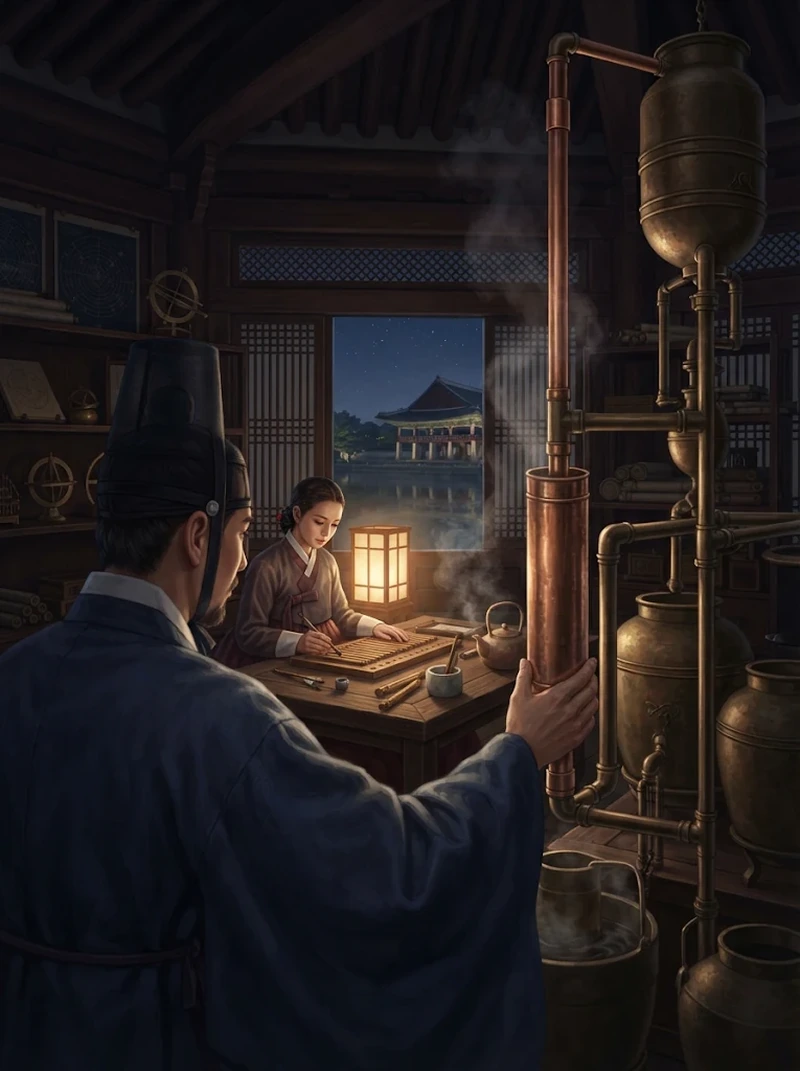
Disguised thoroughly inside crates of northern meteorological specimens, the four hundred catties of star-iron harvested from the slopes of Mount Baekdu were secretly brought into the Royal Guard armory and the Royal Foundry of Gyeongbokgung Palace at dawn on the first day of the eleventh month. To evade the watchful eyes of the pro-Ming censors upon their return to Hanyang, Jang Yeong and So-hye abided by the King's nominal order confining them to Heumgyeonggak Pavilion to repair the water clocks—inspecting the clepsydra mechanisms by day while secretly researching the smelting of the star-iron by night.
Yet on the third night after a bitter early winter frost descended upon Hanyang, Jang Yeong's brows furrowed deeply as he cross-checked the Grand Self-Striking Water Clock in Borugak Pavilion against the Jade Clepsydra in Heumgyeonggak.
"Lady So-hye, something is very strange. Compared to last midnight at the exact Rat Hour when I measured the rotational angle of the Big Dipper around the Pole Star with the small armillary sphere, the mechanical wooden jack struck the midnight drum tonight a full four centi-marks—nearly eighty seconds—too late."
Jang Yeong ran his fingertips along the bronze delivery pipe connecting the towering three-tiered water supply jars to the receiving vessel below. The Jagyeongnu water clock was an intricate automaton in which water flowing at constant pressure from the upper supply jars collected in the receiving cylinder, raising a graduated floating rod that tripped a series of brass levers and rolling bronze balls to strike the bells, drums, and gongs automatically.
"The graduated floating rod inside the receiving cylinder is not warped, nor is there a speck of dust on the inclined tracks where the bronze balls roll. That leaves only one possible physical cause: the flow velocity of the water passing through the narrow copper delivery tube is changing with the winter cold."
Rolling up her silk sleeve, So-hye dipped her slender fingers into the lower supply jar. In the drafty pavilion where icy wind seeped through the lattice doors, the water was cold enough to numb her skin. Spreading a reed mat upon the floor, So-hye immediately began comparing the pavilion's temperature logs from the past fortnight against the water clock's daily lag using her bamboo counting rods.
"I have found the law governing it, Master Jang! As water cools toward the freezing point, its internal stickiness—its viscosity—increases invisibly, while at the same time the copper delivery pipe contracts in the cold, narrowing the aperture! Setting up an inverse proportional equation with the counting rods, I found that each time the water temperature drops from mild autumn warmth toward freezing, the flow rate through the tube decreases by three parts in a hundred, accumulating a lag of four to five centi-marks every twenty-four hours!"
Spread across So-hye's counting board, the flow-attenuation coefficients corresponding to each drop in water temperature were arrayed with crystalline precision in rows of red and black bamboo rods.
"Aha! The stars in the heavens revolve at an unchanging pace regardless of winter frost, yet our water clock on earth slows down because cold water grows sluggish and copper tubes shrink! On the fifteenth day of this month, Grand Eunuch Xue Shun of the Ming Imperial Observatory will lead his legation into Gyeongbokgung Palace for an astronomical showdown—if our reference water clock lags because of the cold, our enemies will seize upon that discrepancy no matter how accurate our Chiljeongsan tables are!"
Springing to his feet, Jang Yeong examined the ondol heating flue in the corner of Heumgyeonggak and the bronze tiers of the water jars. If they simply lit a charcoal brazier directly beneath the supply jars to keep the water from chilling, fluctuations in the fire would overheat or evaporate the water, causing the clock to run faster than in summer.
"Is there no way to maintain the water temperature inside the supply jars as steady as spring well-water through all four seasons without applying direct flame...?"
As Jang Yeong pondered, his gaze fell upon So-hye's counting-rod matrix showing the exact ratio between water viscosity and metal thermal contraction. In that instant, a flash of inspiration struck his mind like lightning.
"Following your equation, Lady So-hye, we can replace the single copper delivery pipe between the supply jar and the receiving vessel with a coaxial double-walled copper pipe! Warm water heated gently by the ondol flue will circulate through the outer jacket, while a bimetallic thermostat valve made of layered brass and iron—assisted by a sealed beeswax expansion cylinder—will automatically throttle the warm flow whenever the temperature rises too high, keeping the timekeeping water in the inner pipe at an unchanging spring temperature all winter long!"
"A double-walled copper jacket and an automatic thermal-expansion valve! You are turning the different thermal expansion rates of brass and iron against themselves to lock the water temperature in equilibrium! And if we also attach a small temperature-compensating counterweight to the floating rod inside the receiving cylinder, we can reduce the seasonal error to virtually zero!"
Forgetting the passing of the night watches, the two scholars hammered copper sheets at the Heumgyeonggak workbench while calculating pipe wall thicknesses and thermal transfer rates with bamboo rods. After two days and nights of tireless labor, the spiral double-walled copper pipe and brass bimetallic regulator valve were fitted seamlessly between the supply jars and the receiving cylinder.
At midnight on the third day, Hanyang's temperature plunged well below freezing, coating the edges of Gyeonghoeru Pond with thin ice. Atop Ganui-dae, Jang Yeong measured the exact meridian transit of the Pole Star and the Purple Forbidden Enclosure constellations and waved his signal flag; at that very fraction of a second, the bronze balls inside Borugak tumbled down their tracks and the grand midnight drum boomed across the night sky of Gyeongbokgung Palace. Not a single second of error remained.
"We succeeded, Master Jang! Even in the dead of a freezing winter night, the time of our royal water clock and the stars of the heavens move in flawless harmony!"
With her face glowing with joy, So-hye pushed open the lattice window of Heumgyeonggak. Yet their shared smile lasted only a breath: beyond the palace walls toward Namdaemun Gate, a long column of torches escorting ornate carriages under crimson Ming banners was marching into the capital—Grand Eunuch Xue Shun's imperial inspection legation had arrived in Hanyang ten full days ahead of schedule.