Winter Road: A Dog of Flanders
Episode 2: Wish on the Canvas, Alois at the Windmill
KOXLO AI Studio
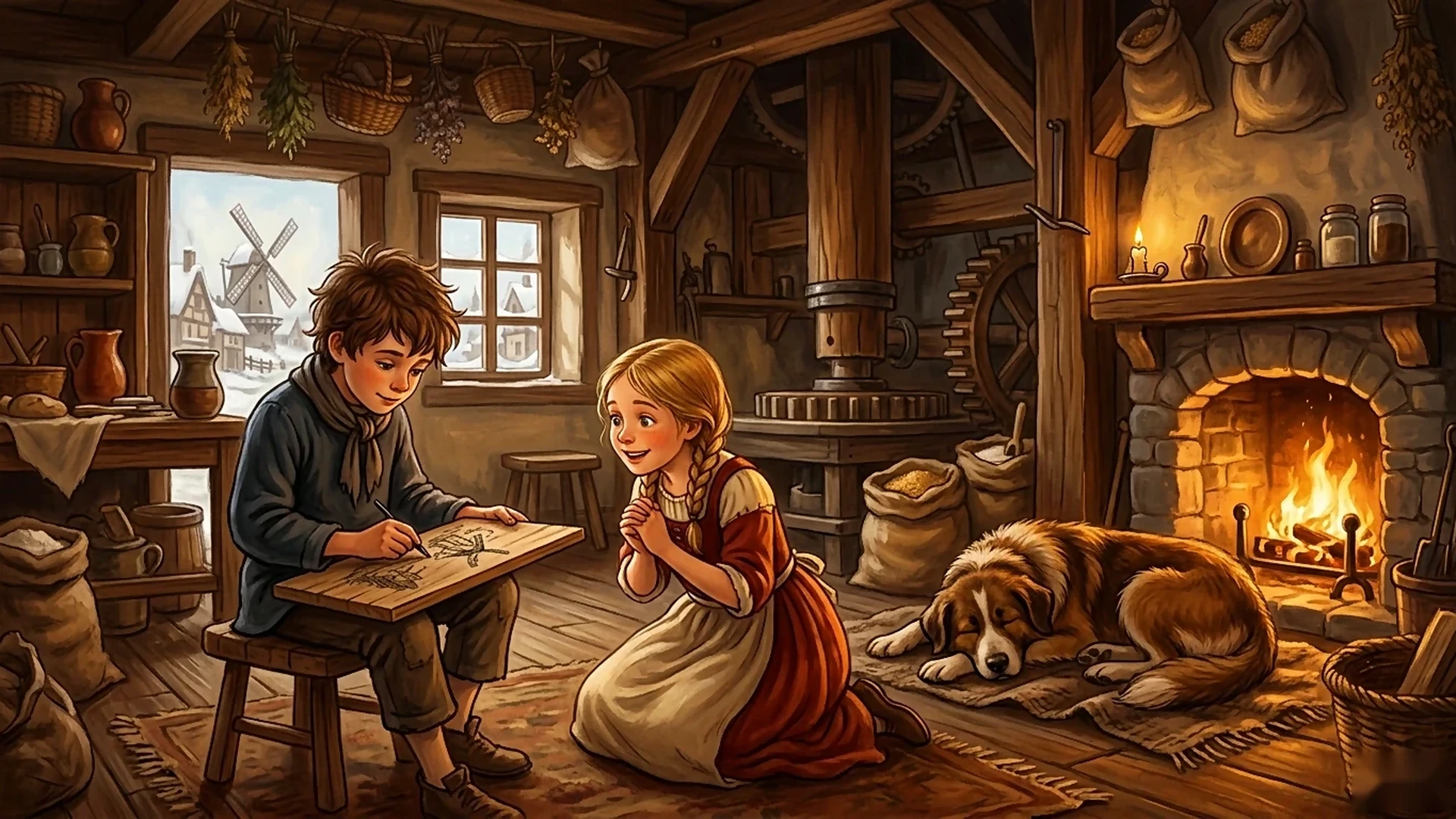
The pale winter sunlight of the afternoon was slanting across the snow-covered rooftops of Hoboken Village. The snow that had been pouring down all morning had subsided for a while, but the bitter cold was still tight in the air. After returning from an exhausting milk delivery in Antwerp, Nero tidied up the cart in the barn, gave Patrasche cool well water and two boiled potatoes, and then headed up the hill behind the cabin. Atop that hill rose a huge red brick windmill that could be seen from anywhere in the village. The windmill's blades, which looked like four outstretched fingers, were spinning slowly in the cold north wind, casting a huge shadow over the snowy field.
Next to the windmill was a beautiful two-story brick mansion with white-painted walls and blue window frames. It was the home of Mr. Cogez, the wealthiest landowner in town. Nero looked carefully over the fence. At that time, the back door of the mansion was wide open, and a girl wearing a red wool coat and a pure white fur scarf came running across the snow as lightly as a butterfly. The girl's name is Alois. She was the only daughter of Mr. Coze, a windmill owner, and Nero's indispensable childhood friend. With curly hair that sparkled in gold, lips as red and pretty as rose buds, and deep blue eyes like a clear lake, Aroa was an angel-like girl loved by the entire village.
“Nero! Patrasche!”
Aroa came running, calling out to Nero in a voice as clear as rolling silver bells. Patrasche ran towards Aroa, wagging his tail violently, and stamped his feet, and Aroa sat down in the snow and hugged Patrasche's neck tightly, rubbing his cheeks. “Patrache, wasn’t it cold this morning too? Weren’t the soles of your feet cold? That’s a good boy!” Nero approached, scratching his head in embarrassment. “Aroa, I heard you have a cold. What should I do if I come outside? The wind is still cold.”
“Hmph, I’ve been staring out the window since morning just to see Nero’s face! My father went to organize the books in the mill warehouse, so it’s okay. Now, look at this!”
Aroa took out a neatly wrapped white handkerchief from his coat pocket and placed it in Nero's hands. It was steaming warm apple pie fresh from the oven and sweetly preserved plums. The sweet, buttery smell of pie spread into the cold winter air.
"Aroa and Nero grew up together from a very young age. As children, unaware of the worldly standards of adults, such as status or the gap between rich and poor, the two children would run around on the green grass of Flanders, weave wreaths of wild poppies and place them on each other's heads. In the summer, they would sit under the shade of a willow tree by the canal and burst into laughter as they watched Patrasche splashing around in the water. In the fall, Aroa's mother, Mrs. Koze, would walk through the golden barley fields to gather fallen grain, and she took pity on Nero and often gave him warm bread or milk. However, his father, Mr. Koze, was a stubborn man with a high pride in being the richest man in the village.
"
“Aroa... this is too precious food. I can’t accept it.”
Nero threw up his hands in embarrassment, but Aroa puffed out his cheeks and made a sulky expression. “Chi, it’s like that again! I took it from the kitchen without my mother’s knowledge to give it to you. If you don’t eat it, I’m going to cry here! Share it with Patrasche, come on!” In the face of Aroa's warm and stubborn eyes, Nero could no longer refuse. Nero cut the pie in half and put the larger piece into Patrasche's mouth. Patrasche swallowed, wagging his tail, and licked Nero's hand in satisfaction.
Nero also carefully took a bite of the pie. The sweet and sour apple juice and the scent of cinnamon spread throughout my mouth through the crispy pie crust, and the frozen blood in my body seemed to warm up. As the boy's stomach, which had been sore from hunger, was filled with warmth, tears welled up in the corners of Nero's eyes.
“Is it delicious, Nero?”
“Yes... it’s the most delicious thing in the world. Thank you so much, Aroa.” “Hehe, I knew so. By the way, Nero! Did you bring what you promised last time? The one you drew on the wooden plank!”
Aroa pointed to Nero's coat pocket with sparkling eyes full of anticipation. Nero smiled shyly and took out a square, flat piece of fir plank from his pocket. Last week, I picked up an old plank covered in shavings that had been discarded on the floor of a carpentry shop along the Antwerp road, polished the surface smooth with a whetstone, and carefully painted it with charcoal powder and red ocher soil. On the wooden plank, there was a surprisingly vivid portrait of Aroa wearing a fur hat and smiling brightly, with a snow-covered windmill in the background in the middle of winter.
The delicate texture of the girl's flowing golden hair, the deep shadows of her sparkling eyes, and the soft volume of her gently rising cheeks were perfectly captured with a brush stroke as genius as that of a professional painter's oil painting. In the corner of the picture, the dignified profile of Patrasche, who reliably stands by Nero's side, is also drawn affectionately.
“Oh my...!”
Aroa covered her mouth with both hands and let out an exclamation. “Is this really me, Nero? How can you draw so dazzlingly with just charcoal, without paper or paint? It’s as if I’ve transferred my soul into the mirror!”
“Do you like it, Aroa? Because you are the prettiest thing in the world when you smile... I really wanted to leave you with that smiling face.”
“I love it! It’s the most precious treasure in my life. I’ll keep it by my bedside every night!”
Aroa held the plank tightly to her chest and spun around on the snow field as if dancing. It was the exact moment when the pure laughter of two children echoed across the silver snow field. “Aroa! What on earth are you doing there now!” A roar like thunder shook the hillside. When Nero and Aroa turned their heads in surprise, a large middle-aged man with a grim expression was standing at the fence gate of the red brick mansion. A man wearing a thick leather coat and carrying a stout ash cane—Mr. Koze, the miller, Aroa's father. Mr. Koze's face was red not only from the bitter cold, but also from boiling discomfort and anger. “Ah, father...!”
Aroa looked terrified and tried to hide the plank behind his back, but he couldn't avoid Mr. Koze's harsh gaze. Mr. Koze walked across the snow field with heavy boots thudding. Next to him was Hans, a sneaky worker at the mill who always followed him with a wicked smile. “Aroa, didn’t this father tell you repeatedly! Don’t hang around with such a base beggar boy! You are a child who is going to be married into a certain family in the future, but you are rolling around in the snow and flirting with the village milkman!”
Mr. Koze glared at Nero as if he were looking at a bug. His contemptuous gaze ruthlessly scanned Nero's tattered overcoat and holey clogs. Nero's face turned bright red with shame and humiliation. He was used to being looked down on by the world because he was poor, but being treated like this by the father of Aroa, whom he cherished the most, was as painful as a knife cutting through his heart. Patrasche sensed his master's pain and threat, growled lowly, and stood in Nero's way. Crumbling... When the huge, yellow-brown dog stared at Mr. Koze with sharp eyes, Mr. Koze was startled and took a half step back. “How dare this wild beast growl at someone! Will he come to his senses if he tastes the stick!”
When Mr. Coze raised his staff, Nero urgently wrapped his arms around Patrasche's neck. “No, Patrasche! Be quiet! Uncle Coze, I’m sorry. Patrasche didn’t mean anything like that!” Aroa begged, holding on to his father's coat sleeve with tears in his eyes.
“Father, Nero is not a bad child! He is the kindest and most sincere child in the world who delivers milk to Antwerp early in the morning every day. And look at this, Nero drew this pretty picture for me!” Mr. Koze's eyebrows twitched as he accepted the fir plank that Aroa had carefully held out. The moment he saw the picture, a surprise that could not be hidden passed through Mr. Koze's eyes. This was because the loveliness and vitality of his daughter Aroa was so perfectly alive and breathing on the board that it was hard to believe that it was drawn with rough charcoal powder.
But Mr. Koze soon snorted coldly. To him, art was nothing more than an idle waste of money for the aristocrats or a shameless buffoon for the poor to escape reality. “Hmph! What’s the point of scribbling on tree bark with black charcoal? It’s just a useless thing that will make you starve to death. You don’t even think about plowing the dirt or planting potatoes, and you’re just wasting your time like a clown!”
Mr. Koze roughly placed the plank in Aroa's hand and issued a cold threat to Nero. “Listen carefully, Nero. Don’t go near my wall again. Don’t talk to Aroa or give him these useless toys! My daughter will marry into a wealthy merchant in Antwerp or a landowner in Brussels. It’s a disgrace to the family that the name of a beggar boy like you is even on my daughter’s lips. Do you understand?!” “Father, please don’t do that! Nero, don’t cry…!”
Aroa burst into tears and was dragged away, but Mr. Koze snatched his daughter's wrist and mercilessly entered the mansion and slammed the front door. Crash. The sound of a heavy latch being locked echoed coldly across the frozen hill. Nero stood on the snow field in a daze. A sadness that was colder than the sharp wind that brushed my cheeks penetrated my heart. His poverty and the difference in status and situation left a deep, indelible scratch on the heart of the most innocent boy in the world. Sigh. Patrasche leaned his large head on Nero's thigh.
The warm eyes of the silent dog were whispering to the boy. ‘Don’t cry, Nero. I know your heart. Even if the world doesn't know what a pure and great artist you are, I know.' Even after the heavy shutters of the windmill were closed, Nero stood frozen in place for a while. Cold snowflakes piled up on the boy's matted hair and thin shoulders. Through the crack of the mill window, he caught a glimpse of Aroa looking at him, wiping away tears. Next to Aroa, the sad sight of her mother, Mrs. Koze, was seen trying to comfort her daughter.
Madame Coze quietly held her hands together as if she was sorry toward Nero outside the window, but there was nothing she could do in the face of her stubborn husband's disapproval. Poverty was such a cold and cruel thing. A huge cliff that could not be overcome with just a pure heart was weighing down on the young boy's small shoulders. Nero hugged Patrasche's neck and sat down on the snow-covered hill. The hot tears that fell from the boy's eyes hit the snow and created small holes.
'The sound of footsteps awakens the silence, and the memories hidden beneath come back to life. When you and I align, the world becomes our own stage.' “Patrache... am I really a useless child? Are the pictures I drew... just a vain dream perfect for starving to death?”
king! Patrasche shook his head resolutely and licked Nero's cheek. My whole body seemed to tell me that this was absolutely not the case, that your painting was as brilliant and beautiful as Rubens. Nero roughly wiped away his tears with his sleeve. "Yes... I won't give up. I won't give up, Patrasche. Just because I'm poor doesn't mean my dreams can become poor. With my own hands, I'll complete a great painting that will touch the hearts of people in the world... and make even Uncle Cozet and everyone in the world acknowledge me." Nero came down the hill with Patrasche and returned to the old hut.
Inside the room, Grandpa Yehan was sitting wrapped in an old blanket, and when he heard Nero coming in, he turned his head with difficulty. “Nero... isn’t it really cold outside? Why is your face so pale...?” Nero smiled brightly and approached his grandfather.
“It’s nothing, Grandpa. It’s just that the wind was a little bit cold. Did you take your medicine well?”
“Oh? My neighbor, Mrs. Michel, brought me some warm goat milk and I drank it. By the way, Nero, there was some news that old Peter, the cathedral’s sacristy manager, passed by and told me.” Nero's ears perked up at his grandfather's words. “News? What news, grandfather?” The grandfather took out a folded printed matter from an old dresser and handed it to Nero. It was an official notice distributed throughout Flanders by the Royal Academy of Fine Arts Antwerp. The top of the notice was printed in large type with a colorful lion symbol. [18th All-Belgium Youth Art Competition held]
Nero's eyes began to tremble violently. He read the notice word by word with trembling fingers. Eligibility: Youth residing in Flanders and Brussels under the age of 18 (regardless of status, origin, or education)
Topic: [Flanders’ life and faith, or the nobility of labor]
Specification: Large woodblock print or oil painting with at least 3 characters vertically
Deadline for submission: December 24th, noon, Special Examination Room, Antwerp Cathedral Cloisters
Benefits for winning first place: A prize of 200 francs.. A 3-year fully government-funded scholarship to study abroad at the Royal Academy of Fine Arts in Rome and the opportunity to become a direct disciple of a master painter.. 200 francs! That was a huge amount of money that a poor worker could only afford if he had saved it for three full years without spending a single penny. If only I had that money... I could pay the rent on the dilapidated cabin and cook my grandfather warm meat stew and good medicine every day. I was able to feed Patrasche plenty of fresh meat and bones every day, and I was able to spend my whole life drawing without worrying about what others thought.
Plus, studying abroad in Rome! It was an opportunity to formally learn painting in Rome, the mecca of art, where the great Rubens walked around as a young man and learned about Michelangelo and Raphael. It was the only miracle and salvation bestowed by God on a poor country boy like Nero.
“Grandfather...! This competition... can I participate too? Isn’t it only children from noble families or rich families who can participate?”
Nero's voice trembled with excitement. The grandfather smiled kindly and gently stroked his grandson's head. “Oh, Nero. Doesn’t it say, ‘Regardless of status or education?’ God never ignores the sincere souls of the poor. When I look at the pictures you usually draw, it seems like the bright flowers that your mother loved when she was alive are blooming just like that. You definitely have a talent given by heaven.” "grandfather...!"
Nero buried his face in his grandfather's dry chest. Nero carefully folded the notice and placed it in the deepest pocket of his old woolen shirt, where his heart beat. Even though it was only a piece of paper that touched me, a hot heartbeat spread throughout my body, as if a small ember was burning in my chest.
'Rome... the eternal city where the great masters of art lived... If I could go there, I would be able to draw beautiful pictures for children like me who cannot learn because they are poor, and I would be able to tell the whole world about the sacred images of the nameless ordinary farmers and working animals of Flanders.' The grandfather smiled happily as he looked into his grandson's eyes. Although his body was old and sick and he could not do anything for him, his insight to recognize the extraordinary light in his grandson's soul never grew old.
“Nero, Master Rubens always said this when he was alive. What is more important than technique is a sincere heart, and what is deeper than flashy colors is love. Capture the love you have on canvas. Then, the judges’ frozen hearts will surely melt.”
“Yes, Grandpa! I will definitely do that. I won’t forget what you said.” The humiliation and sadness he had received from Mr. Koze were washed away in an instant, and hot passion and courage welled up like lava from the bottom of the boy's heart. But the joy was short-lived, and Nero soon ran into a huge, realistic wall. 'Large canvas of more than 3 characters vertically...'
Nero did not have the money to buy a large canvas or even a single centime to buy oil paints or brushes. There are only about ten days left until the contest deadline. How can a boy with no paper or canvas complete a masterpiece that will surprise the world? As the night deepened, the bitter night wind blew outside the window again, knocking on the creaking shutters. Nero, lying face down on the floor of the hut, rested his chin and was deep in thought. The last remaining wood in the fireplace was spouting red embers and crackling, and Patrasche was curled up at Nero's feet, warming his feet. 'If you don't have paper, let's get a wooden board. If you don't have paint, you can use charcoal, dirt, pine sap, and ash. Even Mr. Rubens probably didn't start with colorful paints from the beginning.'
Nero's eyes shone with determination. 'What kind of picture should I paint... The nobility of Flemish life and labor... Yes!'
A scene flashed through Nero's mind like lightning. It was not a fancy aristocratic ball or mythical angels. In a bitterly cold field during a blizzard, an old and sick grandfather pushes a milk cart while suppressing a cough, and Patrasche, who was rescued while covered in blood, pulls the yoke with all his might beside him. A scene of the most holy and pure love, where people can sacrifice their lives for each other even in poverty! That was the true soul of Flanders, whom Nero knew best and loved most deeply with all his soul.
Nero got up, knelt down, and prayed with his hands together. ‘God, please give me the strength to contain that land. 'Please do not let my fingertips freeze and allow me to devote my whole life to this painting for my beloved grandfather and Patrasche.' When Nero raised his head after praying, Patrasche stood up and gently placed his snout on the back of Nero's hand. The dog's eyes contained infinite trust and encouragement toward the boy.
'What will happen at the end of this winter journey? Looking for warmth in a cold world. As snowflakes bloom, we too shine, and if we are together, we are not afraid of any path.' Nero pressed his warm forehead against Patrasche’s and whispered resolutely. “Patrasche. It starts tomorrow. We will draw the best picture that contains the souls of the three of us!”
In the darkness of a cold winter night, the boy's unquenchable artistic spirit began to burn toward a brilliant dawn. In order to prepare a large canvas, Nero decided to finish his milk delivery early the next morning and search the alleys of the shipyards and lumber warehouses in the port of Antwerp. If I could salvage old oak planks or cargo box lids that had been discarded after repairing a ship, I could carefully trim them and turn them into the best canvas. Although there may not be a silk canvas or a sparkling gold picture frame, the wooden plank wiped with sweat and tears would be the most suitable basis for capturing the harsh labor and sublime silence of Flanders.
"Inside the dark room, the boy rummaged through the ashes of the fireplace and picked out a few pieces of hard charcoal that he liked. Although his fingertips were stained black, a pure and confident smile spread across Nero's face, as if he was not afraid of any hardships.
"
The boy and the huge, loyal dog shared each other's breath and endured the darkness of the long winter night together. Although a bitter wind shook the window frames outside, inside the cabin, the light of art was quietly rising, warmer and more sublime than any luxurious palace in the world.