Winter Road: A Dog of Flanders
Episode 1: Cold Wind of Flanders, the Milk Cart and the Boy
KOXLO AI Studio
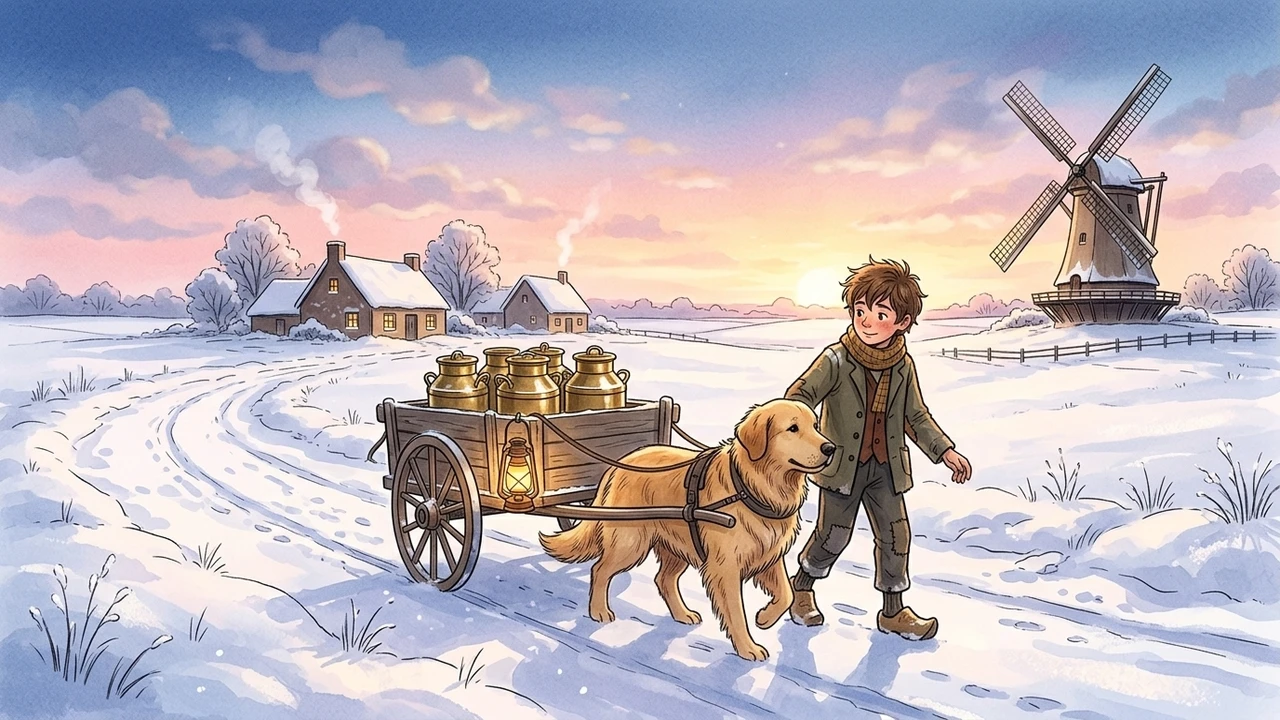
In the early 1870s, the wide plains of Flanders, Belgium, where biting winds from the North Sea blew. The first frost of winter lay white on the dry furrows that stretched far to the horizon, and the bare poplar trees were screaming in sorrow as they were hit by the sharp wind. At the entrance to Hoboken, a small rural village about three miles north of the walled city of Antwerp, an old hut with a crumbling mud brick and thatched roof stood precariously.
It was around five o'clock in the morning, when the dark blue darkness was still thick before dawn, when the door of the small cabin creaked open. The name of the boy who walked out with white breath was Nero. Nero, who turned fifteen this year, was wearing a worn-out, loose woolen shirt, trousers worn at the knees, and a thin linen overcoat. His thin shoulders were hunched over because he could not wear a proper coat due to poverty, but his eyes were shining brightly with a sapphire color as clear and deep as the clear autumn sky of Flanders.
“Good morning, Patrasche. It’s very cold today again.” Nero whispered in a friendly voice to the straw-covered barn next to the cabin. As soon as the words fell, there was a rustling sound in the straw, and a huge, sturdy, tawny-colored Bouvier des Flandres dog came running out, wagging its tail violently. The dog's name is Patrasche. This huge dog, with its rich, dark golden fur like a lion's mane, a wide chest, and four strong legs, was the most loyal and affectionate companion in the world, living only for Nero.
Patrasche looked at Nero with his large, dark brown eyes filled with joy, and placed his warm, wet tongue on the back of his cold hand. Clap, clap. As the dog's hot body temperature passed through Nero's frozen fingers, a bright and warm boyish smile spread across Nero's lips.
“Haha, it tickles. Patrasche, did you sleep well all night? You didn’t catch a cold, right?”
Nero hugged Patrasche's neck and pressed his face against him. The smell of dry straw and warm earth emanating from Patrasche's thick, long fur was Nero's only refuge and sanctuary in the frozen world. From the back room of the cabin, along with the sound of a creaking bed, an old man's voice was heard coughing dryly. “Nero... are you awake already...?”
Nero hurriedly closed the barn door and stepped into the cabin. In a dark and gloomy room, with a pile of ashes rising from an old fireplace, a thin old man was lying with a blanket up to his neck. It was Jehan Daas, Nero's maternal grandfather, his only blood relative and everything in the world. Grandfather Yehan, now over 80 years old, was a veteran soldier who was conscripted in the Napoleonic Wars when he was young and was crippled after being hit by a shell fragment in one leg. Although he had lived an honest and noble life tilling the dirt of Flanders all his life, the weight of time, severe arthritis, and chronic asthma were eating away at the old man's body to the core. “Grandpa, your cough has gotten worse again. The sun is still far from rising, so please lie down some more. I will keep the embers alive.”
Nero hurried to the oven, added dried pine cones and twigs he had picked up from the mountain yesterday, and lit a fire. Acrid smoke rose, but soon small scarlet flames began to crackle, filling the room with a little warmth. The grandfather stretched out his trembling hand and caressed Nero's cheek. The old man's hands were rough and dry, but the love conveyed through his palms was deeper than the sea. "My kind grandson... I'm sorry for putting this difficult burden on you at such a young age. I couldn't fulfill it, so I left the milk delivery to only you and that good animal... My sin is great." “Don’t say that, grandfather. If you hadn’t been here, I wouldn’t have been in this world. And going out into the city with Patrasche is not difficult at all. Walking the morning streets of Antwerp is my greatest joy.”
Nero smiled bravely and comforted his grandfather's blanket. Nero's mother died alone in a foreign country when Nero was a baby, leaving a lump of young blood to the old man. To Nero, who could not even remember his father's face, his grandfather Yehan was his father and mother, his teacher, and the support of his life. Even in poverty, my grandfather always spoke to Nero. ‘Nero, even if a person starves to death, he must never covet others or tell lies. A clear conscience is the brightest jewel that a poor person can offer to God.'
Nero grew up holding his grandfather's teachings like a jewel deep in his heart. As the water boiled in the kettle next to the fireplace, Nero placed a cup of warm tea brewed with dried dandelion roots and half a slice of crusty black rye bread on a tray and placed them by his grandfather's bedside. “Eat this and sleep well. I’ll be back around lunch.” The grandfather nodded, wiping away the tears from his eyes. “Be careful. It looks like snow clouds are coming from the north today. The road will be slippery, so keep in step with Patrasche...”
“Yes, Grandpa. I’ll be back!” Nero put on his hat and came out. In the yard stood a small two-wheeled cart with old wooden wheels whose green paint was peeling off. The cart was the only means of livelihood for poor peasants near the village of Hoboken, carrying barrels of fresh milk from their cows and delivering it to regular customers inside Antwerp Castle. Driving a cart back and forth to the city only gave them a few centimes a day, but it was a lifeline that allowed the family of three, Nero, Grandfather, and Patrasche, to buy rye bread and survive the winter.
Most of the people in Hoboken village were extremely stingy or poor tenant farmers who lived from day to day. They did not despise the old and crippled veteran Yehan and the parentless young Nero, but because of their difficult lives, they could never afford to extend a warm hand. Only Mr. Cogez, the owner of the village's huge windmill and a large landowner, lived affluently with a large mansion and fertile fields. However, Mr. Koze was a very strict and quick-calculating man, and he always had a cold attitude toward the poor, seeing them as examples of laziness.
"Nevertheless, a lamp was burning in Nero's heart that could not be extinguished by any rain or wind. It was a blind love for painting and pure compassion for all things in the world. Nero was a boy who knew how to discover the beauty of God's hand in even the wild grass on the side of the road or the icicle hanging from the end of the eaves.
"
As Nero lifted the leather yoke, Patrasche approached with a familiar gesture and pressed his chest against the front of the cart. Patrasche was not originally a dog that pulled milk carts. A few years ago, a violent and cruel junk dealer and pot seller who traveled between Brussels and Antwerp chained Patrasche, made him drag a heavy iron pot, and brutally whipped him. It was young Nero and Grandpa Yehan who found the huge dog, unable to drink a sip of water under the scorching midsummer sun, covered in blood, abandoned in a roadside ditch, panting and dying.
Even though the two people were in a situation where they didn't even have enough to eat, they couldn't bear to ignore that pitiful life. Little Nero crawled down into the ditch, dipped his little handkerchief in the stream, moistened the dog's dry tongue, and together with his old grandfather, with all their bone-breaking strength, they loaded the huge dog into a cart and brought him to the cabin. Over the next few weeks, Nero nursed him day and night, breaking his own bread, soaking it in milk, crushing herbs he picked from the fields and applying them to Patrasche's bruised back and nape.
When Patrasche miraculously opened his eyes and licked Nero's hand, a soulful pact was made between the dog and the boy that cannot be fully expressed in human language. To Patrasche, who learned only distrust and fear of humans through abuse and starvation, Nero was an angel and a god who descended on the world. As soon as Patrasche regained his health, he saw his old grandfather struggling to pull the milk cart, so he went up to the yoke, stuck his head in, and insisted on pulling the load himself. From that day on, Patrasche never left Nero's side for a single day, and they walked together on all the roads of Flanders.
Nero carefully tied Patrasche's thick chest belt and added soft cloth to prevent the leather strap from digging into the skin. “Patrasche, please do me a favor today as well. Don’t overexert yourself and let’s go slowly.”
king! Patrasche barked in response in a low, reassuring voice. Clatter, rattle. The cart with four tin milk jugs finally started rolling down the cold gravel road. The eastern sky was slowly changing from gray to light silver, but on the northern horizon, heavy, black-gray snow clouds were approaching with terrifying force. The boy and the dog walked side by side.
'Following the snowy road, the wind passes by my face coldly. Even if my fingertips freeze, I can't stop walking this winter road with you.' Whenever the wind grew stronger, Patrasche blocked the north wind with his huge body and walked close to Nero's leg. Nero blew on his cold hands and took out a small flat stone and piece of charcoal from his pocket that he had picked up yesterday and fiddled with them. Those boulders and pieces of charcoal were the key to the world's most sublime dream that Nero's soul harbored. On both sides of the road leading from Hoboken village to Antwerp, huge windmills, the symbol of Flanders, were endless.
The huge windmill blades were spinning with a heavy screeching sound as they were hit by the sharp wind. The ice was thick in the ditches along the road, and the frost on each blade of grass sparkled sharply like shards of glass in the morning sunlight. Nero's old clogs were thin, so the cold of the frozen dirt road directly penetrated the soles of his feet. The tips of his toes were frozen to the point of loss of sensation, and every time he took a step, he felt a sharp pain like a needle, but Nero never complained or stopped. Instead, he hurried his steps and patted Patrasche's back affectionately.
“It’s cold, isn’t it, Patrasche? Just a little further is the gates of Antwerp. After today’s delivery, I’ll get you some warm oat biscuit crumbs from the bakery on the corner of the cathedral square.”
Every time Patrasche heard Nero's voice, he perked up his ears and gently waggled his tail. Neither the bone-chilling cold nor the weight of the heavy tin bucket were any obstacles to the dog. Only the fact that Nero was by his side and that the boy's clear eyes were looking at him made Patrasche's whole world a warm spring day. About an hour and a half after leaving the village, a majestic and huge spire began to rise above the foggy horizon in the distance. It was the grand spire of the Cathedral of Our Lady, Antwerp.
The gigantic Gothic spire, 123 meters high and visible from anywhere in the Flanders Plain, boasted a majestic and sacred appearance, like the fingers of a giant praying to the sky. As soon as the spire came into view, Nero's heart began to pound violently. Antwerp Cathedral was not just a religious sanctuary for Nero. It was the most pure temple dedicated to Nero's soul, where the immortal masterpieces of the great painter Peter Paul Rubens rested.
“Patrasche, look over there! It’s the cathedral spire! It’s where Rubens’ painting is…!”
Nero's voice trembled with excitement. Nero, a poor, bare-chested country boy, had a natural talent and burning passion for painting. He had never formally studied painting, nor had he ever held a high-quality canvas or oil paint in his hands. However, every time he saw the sway of wildflowers in the field, the sunlight breaking through the leaves of poplar trees, the curves of swans swimming in the water mist, the deep wrinkles on the old grandfather's forehead, and the warm look in Patrasche's eyes, an uncontrollable desire for painting arose in Nero's heart.
As I passed under the windmill blades, the dull vibration of the millstones grinding the grains accompanied by the delicious smell of flour was carried by the wind. The huge windmill owned by Aroa's father was the heart of the town of Hoboken and a symbol of wealth. Beneath the windmill was a beautiful mansion with red tiles painted white, and in the yard were fat geese and a well-groomed orchard. Every time Nero passed in front of that house, he would slow down. It was because of the excited anticipation that Aroa, who woke up early in the morning, might open the window and wave.
But today it was so cold that all the windows were tightly closed. “Patrasche, I guess Aroa is still sleeping. He said he had a cold yesterday, so I hope he gets some rest in a warm room.”
“Patrasche snorted and waggled his tail as if he knew what Nero was thinking.”
As they approached the gate, the gate guards wearing thick fur coats and carrying spears glanced harshly at Nero's chariot. “Hey, Hoboken kid! You’re the first one here today too, rattling a tin. Come on by, it’s windy so we have to close the door!”
“Thank you, Mr. Gatekeeper! Have a nice day!”
Nero politely took off his hat, bowed, and entered the castle gate with Patrasche. The streets of Antwerp's old city center were intertwined with narrow cobblestone alleys that still retained the atmosphere of the Middle Ages. The shops were not yet open, but the delicious smell of freshly baked baguettes and rye bread rose with smoke from the bakery chimney, irritating Nero and Patrasche's hungry noses. Growling. A small rumbling occurred in Nero's stomach. I had not even been able to eat half a piece of hard bread for breakfast. Patrasche stopped walking and looked up at Nero with worried eyes.
“It’s okay, Patrasche. I’m not hungry. Let’s finish delivering the milk first.” Nero knocked on the backyard doors of his regular mansions with familiar steps. A ladleful of white milk, freshly poured from a tin, was given to each of the maids at the residence of Mr. Van Broek, a notary, at the house of Mr. Mayr, a wool merchant, and in the alley of an old apothecary. They would hand the poor country boy thin coins worth a few centimes, or occasionally crusty crumbs of bread.
“Come on, kid. There’s no tip. I won’t leave you alone if you mix water with milk, so just know that.”
Even in front of doors that closed tightly with cold words, Nero always bowed his head and never forgot to say thank you. “Yes, thank you. I’ll see you again tomorrow with fresh milk!” By the time he had finished delivering all the milk, Nero had exactly eight small copper coins jingling in his pocket. It was a holy and painful price to pay to keep the boy, the old man, and the huge dog alive for one day. After completing the delivery, Nero headed to the Groenplaats square in front of the cathedral, as always.
In the middle of the square, a huge bronze statue of the great master Rubens stood tall. At the foot of the statue of Rubens, standing proudly holding a palette, Nero looked up in fascination. 'Teacher... Will I be able to draw pictures that convey warm light and emotion to people's hearts like you someday? 'Can a poor child like me, who has no paper or paints... become an artist?'
The wind blew more fiercely, and small snowflakes began to flutter on the floor of the square. Nero left Patrasche seated under the pillars of the square cloister, pushed open the cathedral's heavy oak door, and entered. Squeak—
The interior of the cathedral was filled with deep silence and the smell of sacred candles, in contrast to the harsh wind outside. The faint daylight shining through the high vaulted ceiling and stained glass softly illuminated the marble floor. Nero held his breath and walked on tiptoe toward the main altar. There hung the two great altarpieces that Nero revered and yearned for the most in the world. 《Winter Road (The Dog of Flanders)》, and 《Winter Road (The Dog of Flanders)》. But those great masterpieces did not appear before the poor boy's eyes.
A thick, heavy green velvet curtain was drawn in front of the paintings, and to open the curtain and view the paintings, one had to pay a hefty admission fee of one silver coin—the equivalent of a few days' wages for a poor laborer. Nero fingered the eight jingling copper coins in his pocket. Even if all this money was spent, it was not even one-tenth of a silver coin. And if these coins were spent, Grandfather and Patrasche would have to starve tonight. Nero knelt under the green velvet curtain. Hot tears flowed from the boy's eyes while he only looked at the corner of the golden picture frame peeking through the gap in the curtain.
'God... please allow me the opportunity to pull back that curtain just once and see Mr. Rubens' painting in its entirety. If only I could see that painting clearly with my own eyes... I would not hesitate even if I were to die...' At that time, Patrasche walked in cautiously from the back of the cathedral and sat down next to Nero. Originally, dogs were not allowed in the cathedral, but early in the morning, when the church keeper, Father, had not yet woken up, Patrasche sensed his owner's sadness and sneaked up to him. Patrasche licked Nero's cheek with his wet nose, as if wiping away his tears.
“Patrasche... I’m fine. I’m not crying.”
Nero wiped away his tears and hugged Patrasche's neck tightly. “But one day, I will definitely see it. I will draw a great picture with my own hands, and I will proudly open that curtain and face Mr. Rubens. Then you and your grandfather will come too.”
After leaving the cathedral, Nero and Patrasche took the empty, creaking milk cart back home to Hoboken Village. The sky was now completely gray, and thick snow began to fall. 'My breath turns white in the cold air, and only your warmth melts my heart. The starlight in the sky that I stopped to look at, falls and shines on our road.' The snowfall became heavier and began to cover the fields of Flanders in white, but Nero's steps were never heavy. In his old chest pocket were two pieces of discarded rough wrapping paper that he had just picked up at the corner of a bakery and a charcoal pen tied with a thread pulled from a blanket.
The boy's heart was filled with a hope as white and dazzling as a snowflake as he thought of sitting by the warm fire pit tonight and carefully drawing the lovely figures of Patrasche and his grandfather on the white wrapping paper. The boy and his faithful dog walked side by side, leaving footprints in the howling winter wind. The sound of those footsteps awakened the silence of the cold world, signaling the beginning of countless trials and miracles that would come to them in the future. The field on the way home had already been transformed into a pure white world, as if a silver carpet had been spread.
Every time the wind blew, the dry reeds rustled and sang a pitiful song of winter. Nero's feet felt numb because the snow had soaked into his clogs, but he put his hands in his pockets and clutched a piece of charcoal powder, forgetting about the cold. 'The world is sometimes cold and heartless, but I have grandfather and Patrasche by my side who always believe in me. And there are countless paintings that will bloom at my fingertips.' Patrasche took thick, powerful steps that matched Nero's pace. The imprint of the boy's clogs on the snow and the four footprints of a large dog stretched out beyond the white horizon, shoulder to shoulder, drawing a beautiful line that seemed to continue to the end of the world.
The warm breath of the two souls was gently thawing the frozen winter field, along with the gentle creaking sound of the windmill in the wind.